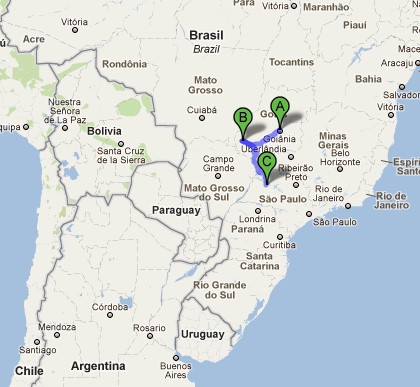
 ready to begin our journey south. My travel companions advise me that it is quite cold in the south and I begin to fear that I have not packed well with only one pair of jeans and one long sleeve shirt. At least I brought my fall jacket and let's be real, I am from the Midwest and cold used to be my winter reality. Junior has to get some work done in the morning but 10:00 A.M. comes early and soon all our suitcases are in the trunk, gas tank is full and we are on
  our way. This day is going to be filled with riding down bumpy roads as we pass a ton of trucks on two lane highways. Not the most relaxing way to start a trip, but the conditions will hopefully improve soon and we will say good bye to them for the most part until our return trip. Once we leave the state of Goias, the road conditions do improve but we soon realize why. It is not due to a different government managing their infrastructure better, it is the fact that a lot of the roads we will travel are privately operated toll roads. And to be quite honest - some of those roads are great and some you wonder why you are paying for them. In the end we will spend R$162.00 on tolls and I wonder what the local people think about paying these tolls.
  Do they realize the money that went into this companies pockets would have been spent at their shops and restaurants. I wonder if they saw a break in their taxes or if they are paying the same amount as before the roads went private, so where is the win for them. But back to the trip, the toll plazas seem to appear out of no where and as method of keeping things even we create a toll /
  parking pot. Every time there is a fee to pay for travel we take it from the pot and when the money in the pot gets low, we each add R$10.00 to replenish it. It seemed like we were adding money all the time but I guess that is the price for good roads in Brazil. It was an expense we did not predict when we discussed saving money by road tripping. But then again I love a good road trip so as long as we don't spend more then airfare would have been, I am good.
The landscape starts with the same fields and grasslands as I shared yesterday but after a while it changes to rolling hills with occasional wooded areas. Even though it is dry, it is beautiful countryside and we passed by towns like: Jatai, Murutinga do Sul, Valparaiso, Aparecida Do Taboado, Aracatuba as we drove. Each town has a white concrete sign at the entrance of the city declaring their identity. They
 all seem like typical small towns in this region of Brazil. With seven foot high walls surrounding the ceramic block homes with their tile roofs and laundry hanging on the line to dry. A posto (gas station) or two on the corner and little luncheonette that serves a lunch buffet of beans, rice, and meat for the locals and truckers traveling down the road. Little stores selling the typical hardware, groceries, produce, etc and each one selling their specific niche. (no K-Marts or Walmarts here)
 On our journey, I spend a little time studying our travel plans and the twenty six states of Brazil (that does not include the federal district which includes Brasilia as it is not actually a state). I learn how there were originally two states which were

controlled by the Portuguese Royal Family. These two states have been divided and the state lines have changed over the decades to their current boundaries. Actually this year the state of Para (in northern Brazil) will be deciding whether to split their state up into two or three different states. I was not able to find out when this decision will be made but we may see a Brazil with twenty seven or twenty eight states soon. As with history in the United States, I find it interesting to learn about Brazil's history and I am sure I will be able to find time to learn while on this road trip. On our current travels, we will be traveling through six of the states: Goias, Mato Grossa do Sul, Sao Paulo, Parana, Santa Catarina, and Rio Grande do Sul. This first day is a lot of driving and little site seeing as planned, but we do stop late in the afternoon at a roadside stand and buy a couple of pineapples. The lady cuts them up for us and we devour them quickly. There is nothing like a fresh picked pineapple for an afternoon snack.

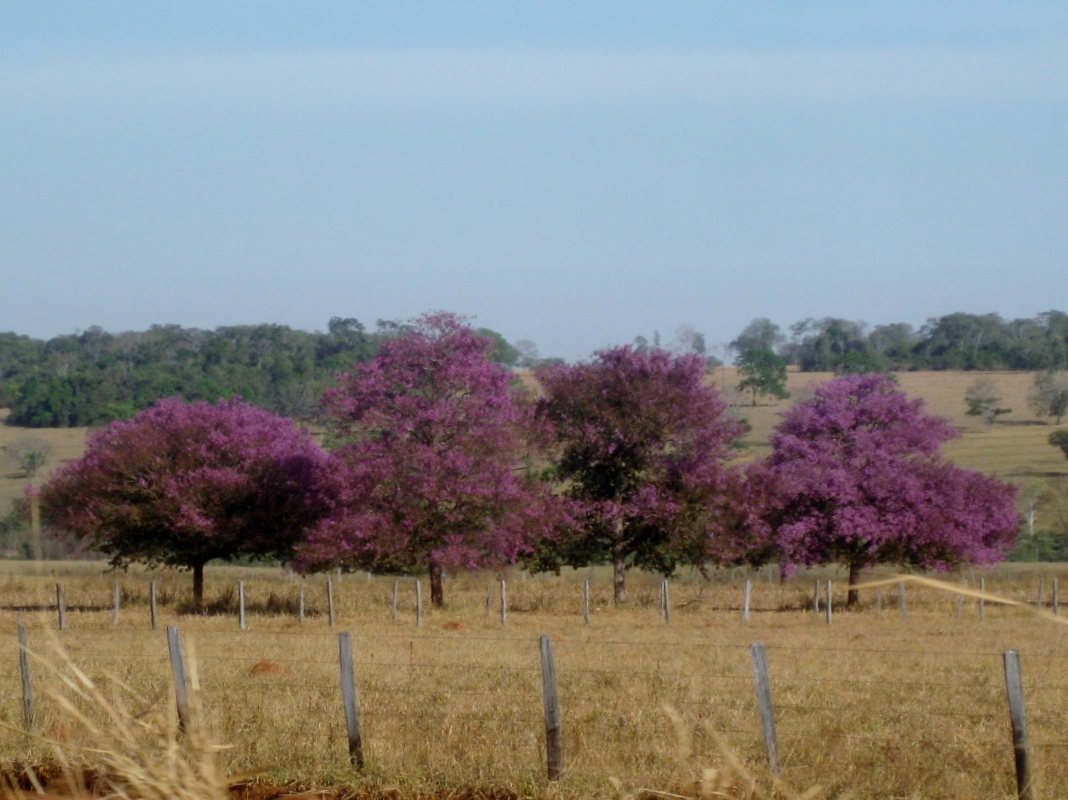
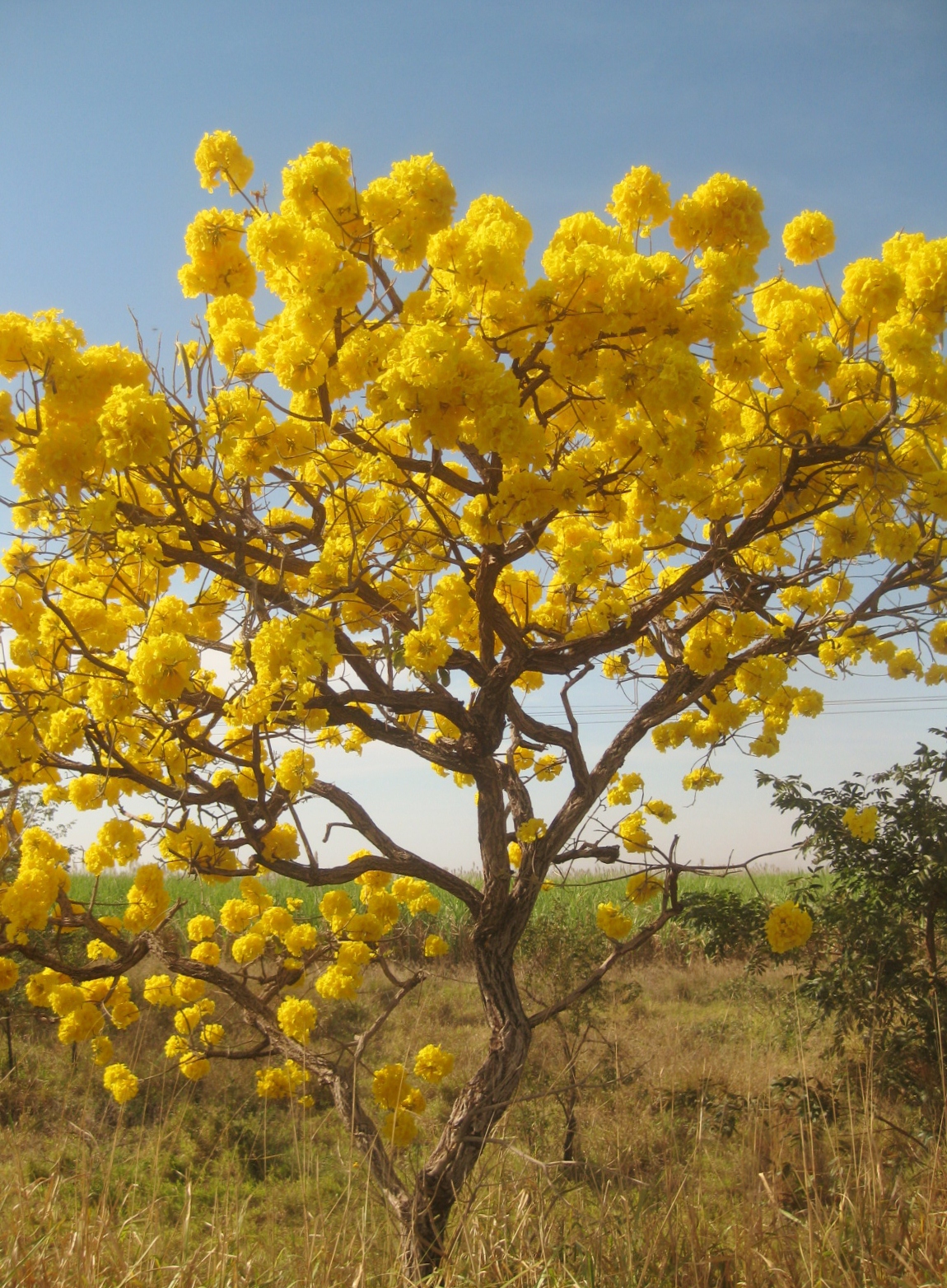
As we drive the many miles of today's journey, the ipe trees appear quite frequently as well. The yellow and purple trees are just as beautiful as the day before and help us pass the time. Soon we come across a huge dam and reservoir. The Represa de Promissao was finished in 1975 on the Tiete River. It creates power for the state of Sao Paulo and is an important part of the states infrastructure. Comparable to the damn in
 Yankton South Dakota in size, but there is no town and only sparse recreational fishing on the lake created by the dam. (no jet skis, boating, summer cabins, etc.) It is a beautiful man made structure and it is not hard to see how powerful it is and how much energy it can create.
Shortly after the sun sets we arrive in Lins Brazil and since it is a little further then we expected to travel today, we decide to stop for the evening. There are a couple of chain hotels but no Marriotts or Best Westerns in town. We end up choosing a local hotel and next on our adgenda is dinner, a nice Brazilian buffet of course. We take a short trip around town and soon find a local restuarant. After eating, we decide it is time to head back and turn in early so we can get plenty of rest and be prepared for the next day of road trip. It has been a great day with little distraction from our journey and a good start to our travels.
(Like Dave's World on Facebook)
 |
| Can you see the macaws? |
 |
| Ipe tree - simply marvelous |
 |
| toll road |
 |
| Another Difference -- Palm trees lining the driveway instead of oak. |
 |
| And the terrain changed! |
To read "Cross Coutry Travel - Day 3" click here